Artham Resources
Half Yearly Sample Question Paper with Solution Class 12 Economics
Half Yearly Sample Question Paper with Solution Class 12 Economics
Couldn't load pickup availability
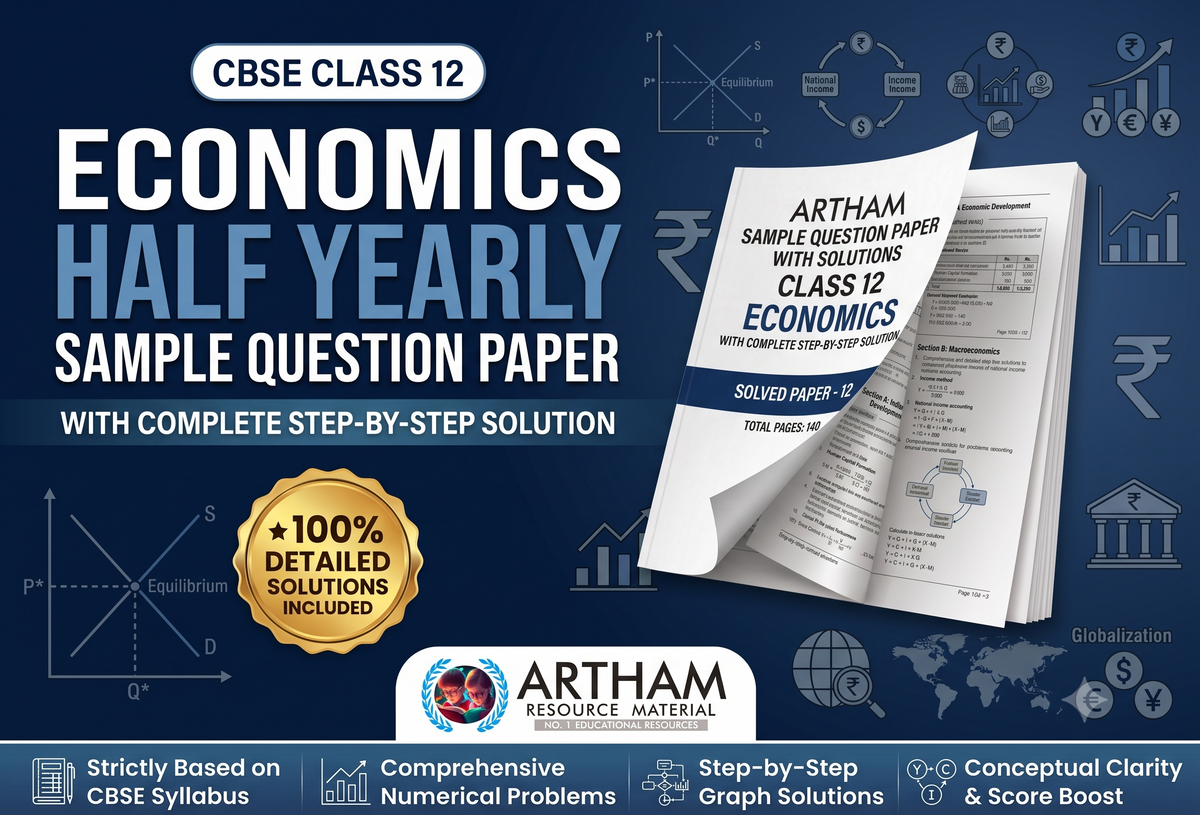
📈 Artham Resources: Class 12 Economics Half-Yearly Sample Question Papers (eBook Edition)
Master macroeconomic models, decode complex economic data, and secure top marks in your mid-term examinations with Artham Resources’ comprehensive eBook of 15 Full-Length Half-Yearly Sample Question Papers for Class 12 Economics.
Meticulously compiled in strict alignment with the latest CBSE curriculum and blueprint for the 2026–27 academic year, this eBook delivers exhaustive practice across both prescribed sections: Introductory Macroeconomics and Indian Economic Development.
✨ What’s Inside This eBook
-
100% CBSE Blueprint Alignment: Strictly adheres to the official 80-mark, two-part exam structure (Part A: Introductory Macroeconomics; Part B: Indian Economic Development), covering high-weightage mid-term units including National Income & Related Aggregates, Money & Banking, Determination of Income & Employment, Development Policies & Experience (1947–1990), and Economic Reforms Since 1991.
-
Complete Step-by-Step Solutions & Value Points: Comprehensive model answers with official-style step marking, highlighting essential economic terminology, neatly labeled graphs/schedules, formula derivations, and structured point-wise explanations for 3, 4, and 6-mark questions.
-
Competency, Case Studies & Data Interpretation: Packed with Assertion-Reasoning questions, contemporary case-based scenarios, macroeconomic news excerpts, and demographic/economic statistical tables designed to sharpen critical analysis and evaluation skills.
-
Mastering Numerical Problems & Diagrammatic Presentation: Intensive practice on tricky National Income numericals (Value Added, Income, and Expenditure methods), Investment Multiplier calculations, and credit creation schedules to ensure zero deduction in marks.
-
Speed, Accuracy & Time Strategy: Trains students to solve 1-mark objective questions quickly, pace through comparative analytical questions, and write well-structured 6-mark policy evaluations comfortably within the 3-hour exam limit.
Share